
Field: Scent, Culture and Nature
How Plant Scents Reflect Their Environment
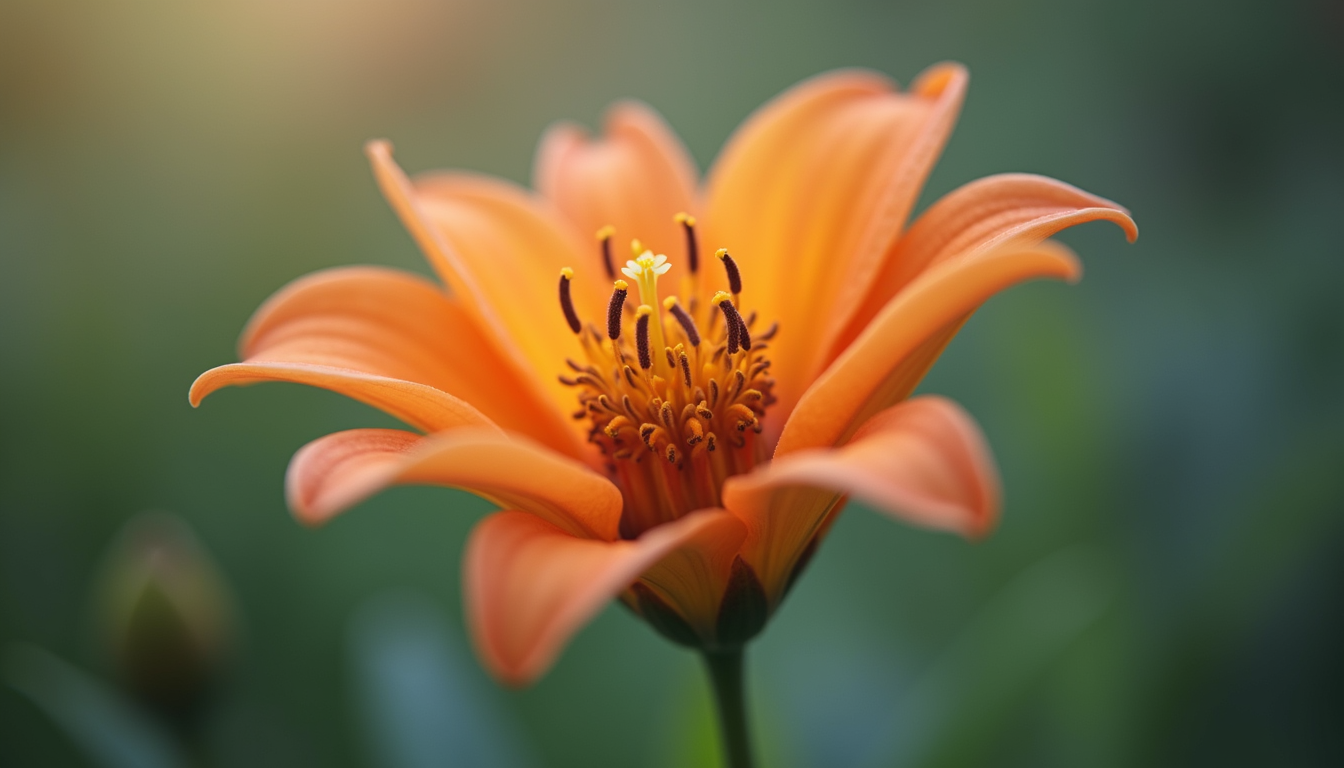
The scents released by plants are not merely pleasant smells. The production and release of volatile organic compounds (VOCs) involve not only the plant's own state, but also temperature, light, and the surrounding environment. Taking plant scent as our clue, we consider the relationships among nature, chemistry, and olfaction.
Research Question
How does a plant's scent reflect the environment in which the plant is placed?
Not Seeing Plant Scent as Mere “Smell”
Walking in a forest. Stepping into a garden after rain. Touching a leaf with your hand. We sense many kinds of scent from plants. But simply sorting them into “the smell of wood,” “the smell of grass,” “the smell of flowers” is not enough to capture the world of scent that plants release.
Many volatile organic compounds (VOCs) are involved in plant scent.
These compounds are released from plants, move through the air, and take part in interactions with surrounding organisms and the environment. Plant VOCs are known to mediate many ecological relationships: between plants, between plants and insects, between plants and microorganisms, and more.
In other words, plant scent can be thought of as one clue for reading the relationship between a plant and its environment.
The Molecules That Make Scent
The VOCs that make up plant scent include several chemical groups, such as terpenoids, phenylpropanoids and benzenoids, and fatty-acid-derived compounds.
Even for the same plant, the compounds released and their amounts are not necessarily constant.
The emission of plant VOCs involves not only the plant's tissues and metabolism, but also environmental conditions such as temperature. Recent research has reviewed how the emission of VOCs, their movement through the atmosphere, and their reception are each affected by factors such as temperature and atmospheric chemistry.
Here lies the fascination of researching plant scent.
The “scent” we perceive is not something fixed inside the plant.
It is released from the plant and becomes a sensation of ours through a process: plant → air → surrounding environment → olfaction.
The Same Plant Does Not Always Smell the Same
Consider, for example, plants of the same species.
Where it grows. The season. Temperature. Light. Water. The plant's own condition.
If these conditions differ, the amounts and composition of the VOCs released may also differ.
In plant VOC research, this environmental dependence is an important theme. The production and emission of plant volatiles change not only with biological factors, but also with abiotic environmental factors.
That is why a single phrase — “this plant smells like this” — cannot fully explain a plant's scent.
The scent we perceive needs to be thought of as a combination of the plant itself and the environment in which it is placed.
Plants Interact With Their Environment Through Scent
Some plant VOCs do more than register as “scent” to humans; they play important roles within ecosystems.
For example, the volatiles released by plants can attract insects and other organisms, and take part in interactions with them.
VOCs are also studied as informational cues in interactions between plants. Responses on the receiving side to the VOCs a plant releases differ depending on the plant species and the surrounding situation; they are highly context-dependent.
What matters here is that this is not the simple story of “plants giving off scent.”
Scent is also part of a complex chemical communication that takes place between a plant and its surrounding environment.
So What Do Humans Sense?
From here, another question arises for our laboratory.
Are the VOCs a plant releases the same thing as what humans sense as “scent”?
The answer is not simple.
Analyzing the composition of the chemicals a plant releases, and examining how humans sense that scent, are different research tasks.
Even with the same chemical stimulus, the olfactory experience may change with a person's experience, knowledge, and context.
Indeed, a 2025 review of the scents of nature summarized that the perception of smell is subjective, and is influenced by personal factors such as age, gender, culture, past experience, and familiarity with a scent.
In other words, between plant chemistry and human sensation, there remain many areas to be researched.
Researching “the Scent of Nature”
What we call “the scent of nature” is by no means a single thing, either.
Forests. Bamboo groves. Soil after rain. Flower fields. The seashore. Gardens.
Each of these environments holds different plants, microorganisms, soil, temperature, humidity, and wind.
The VOCs arising there move through space, and we may be sensing that complex mixture as a single “smell of the place.”
In recent years, research has also been advancing that connects plant-derived VOCs with human olfactory experience, from the perspective of the “smellscape” of cities and green spaces.
This connects to “space and scent,” a theme we want to pursue in our research from here on.
Questions From the Laboratory
At the Sakurai Morika Note Laboratory, we do not classify plant scent by “type of scent” alone; we observe it from multiple perspectives:
plant × molecule × environment × olfaction × sensibility
For example:
- Does a plant's scent change with the season, even for the same plant?
- How are temperature and humidity related to the release of scent compounds?
- How do the VOCs released from a plant change within a space?
- What relationship is there between the compounds confirmed by chemical analysis and the impressions people sense?
- What is involved in a scent that feels “like a forest” or “like a bamboo grove”?
There are questions that still have no clear answers.
That is precisely why, at this laboratory, we first value an attitude of
observe, measure, record — and then think.
The Next Question
Is a plant's scent a characteristic of the plant itself? Or is it something born from the relationship between the plant and its environment?
And how do we sense that complex chemical information as “the scent of nature”?
We will pursue this question from both sides: the observation of plants, and the research of olfaction.
References
- Taufer, F., Pálsdóttir, A. M., & Hedblom, M. (2025). Psychological and physiological responses to smells from nature—potential health benefits for urban dwellers. npj Urban Sustainability, 5, 80. https://doi.org/10.1038/s42949-025-00274-0